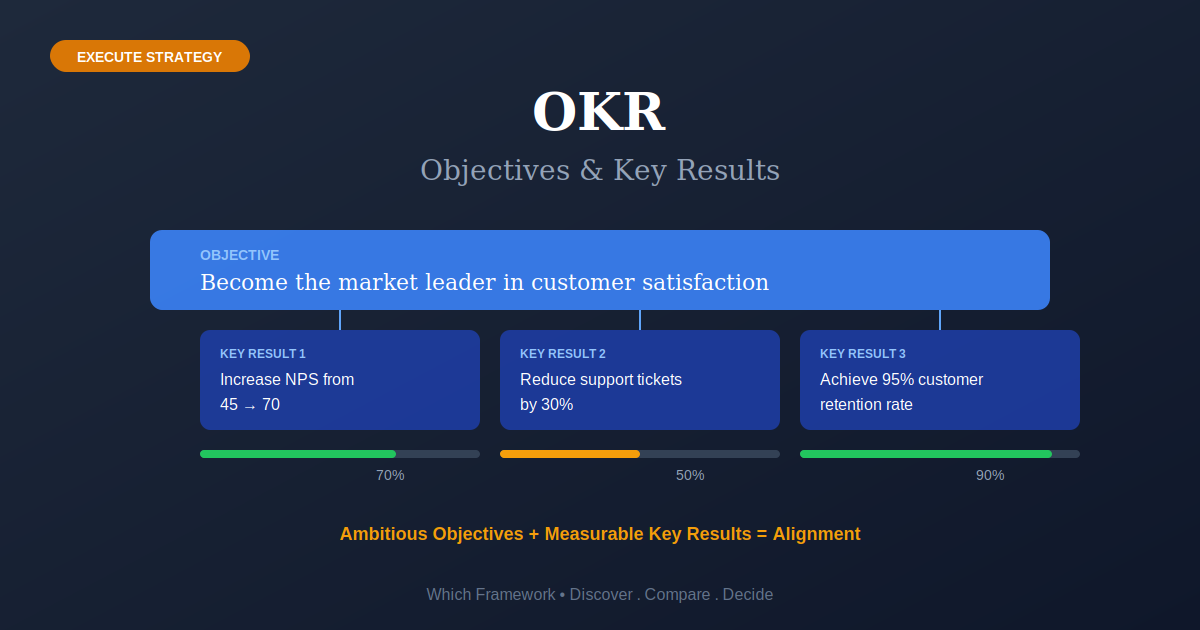
OKR: Objectives & Key Results
OKR (Objectives & Key Results) is a goal-setting methodology that defines ambitious Objectives and measurable Key Results to create organizational alignment, focus, and transparency around what matters most.
What Is It?
OKR is a goal-setting framework developed by Andy Grove at Intel and later popularized by John Doerr at Google. The methodology separates the aspirational "what" (Objectives) from the measurable "how" (Key Results), creating clarity about direction and progress.
Objectives are qualitative, inspiring descriptions of what you want to achieve. They should be ambitious, memorable, and motivating. Key Results are quantitative metrics that measure progress toward the objective—they're specific, time-bound, and verifiable.
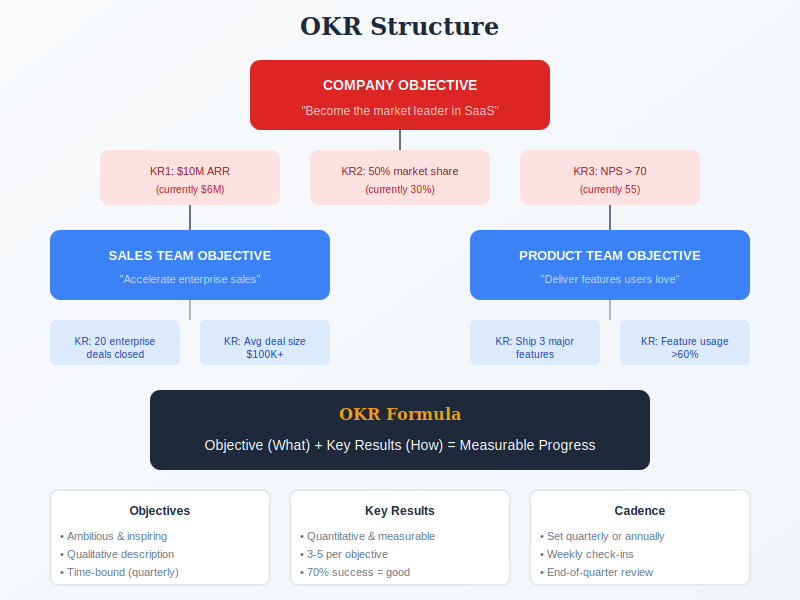
OKRs cascade through organizations: company OKRs inform department OKRs, which inform team and individual OKRs. This creates alignment while allowing autonomy in execution. The framework emphasizes transparency—OKRs are typically visible across the entire organization.
Unlike traditional annual goals, OKRs encourage stretch goals where 70% achievement is considered successful. This psychological shift encourages teams to aim higher than they might with conventional "safe" goal-setting.
Quick Reference
Core Features
- Objectives: Qualitative, inspirational goals that describe what you want to achieve
- Key Results: Quantitative metrics (3-5 per objective) that measure progress
- Cascading Structure: Company → Department → Team → Individual alignment
- Quarterly Cycles: Regular review and refresh cadence (typically quarterly)
- Stretch Goals: 70% achievement is success; 100% means goals weren't ambitious enough
- Transparency: OKRs visible across the organization for alignment
- Decoupled from Compensation: OKRs separate from performance reviews to encourage risk-taking
When to Use
- Your organization needs better alignment across teams
- You want to shift from activity-based to outcome-based thinking
- Teams are working in silos without clear connection to company goals
- You're scaling a company and need a consistent goal framework
- You want to encourage more ambitious goal-setting
- You need transparency about what teams are working toward
- When Balanced Scorecard feels too complex for your organization
When NOT to Use
- Leadership isn't committed to the process (OKRs require top-down buy-in)
- You need immediate results—OKRs take 2-3 quarters to mature
- Your organization has constantly shifting priorities
- Teams can't measure their outcomes reliably
- You're in pure survival mode with no bandwidth for process (consider Lean Strategy)
Key Strengths
- Clarity and Focus: Forces prioritization of what matters most
- Alignment: Connects individual work to company strategy
- Transparency: Everyone sees what others are working toward
- Ambition: Encourages stretch goals beyond comfort zones
- Agility: Quarterly cycles allow for course correction
Key Weaknesses
- Requires sustained leadership commitment (unlike simpler tools like Lean Strategy)
- Can create too much ambition leading to burnout
- Key Results can become gaming targets if poorly designed
- Takes 2-3 quarters to see benefits
- Doesn't work well if coupled with compensation/performance reviews
How It Works
| 1 Primary Input | Company strategy, team priorities, and measurable baseline metrics |
|---|---|
| 2 Data You Need | Current performance baselines, strategic priorities, team capacity |
| 3 Primary Output | Aligned objectives and measurable key results across the organization |
Comparison with Related Frameworks
OKR is one of several strategy execution frameworks. Here's how it compares:
OKR vs Balanced Scorecard
Balanced Scorecard is more comprehensive, covering four perspectives (financial, customer, process, learning). OKRs are simpler and more focused on goals and outcomes. Use Balanced Scorecard for holistic strategy management; OKRs for goal-setting and alignment.
OKR vs Strategy Map
Strategy Map visualizes cause-and-effect relationships in strategy. OKRs are more action-oriented with specific metrics. Strategy Maps show "why"; OKRs show "what and how much." Often used together—Strategy Map for visualization, OKRs for execution.
OKR vs Hoshin Kanri
Hoshin Kanri is the Japanese approach with similar cascading goals but more emphasis on process and catchball (two-way alignment). Hoshin is more rigorous but slower; OKRs are simpler and more agile. Use Hoshin for manufacturing/process-heavy organizations.
OKR vs Lean Strategy
Lean Strategy emphasizes experimentation and rapid iteration. OKRs are better for established goals with clear metrics. Use Lean Strategy when you're still validating direction; OKRs when direction is clear and you need execution alignment.