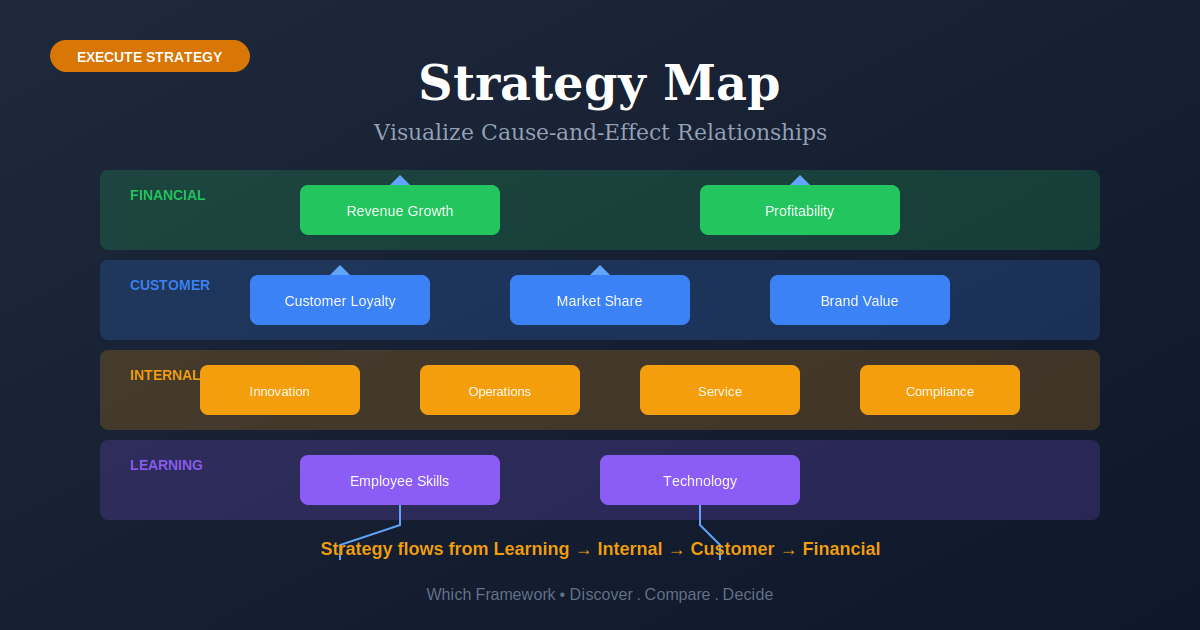
Strategy Map: Visualize Cause-and-Effect Relationships
Strategy Map is a visual representation of strategy that shows how strategic objectives connect through cause-and-effect relationships across four perspectives, making the "story" of strategy visible and understandable.
What Is It?
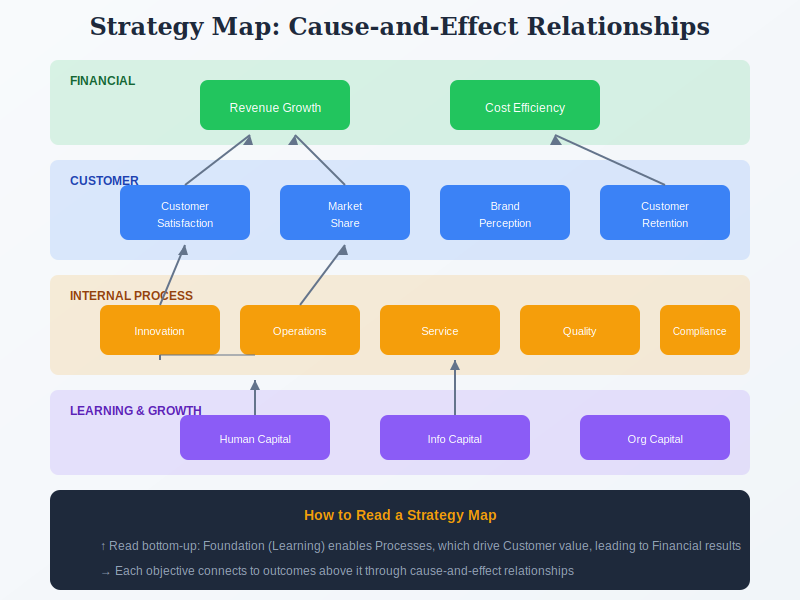
The Strategy Map, developed by Robert Kaplan and David Norton as a companion to the Balanced Scorecard, is a one-page visual diagram that tells the story of how an organization creates value. It shows strategic objectives organized in four horizontal layers and the cause-and-effect relationships between them.
Reading from bottom to top: Learning & Growth (employee capabilities, technology, culture) enables better Internal Processes (operations, innovation, service), which delivers superior Customer value propositions, which ultimately drives Financial outcomes for shareholders.
The power of Strategy Maps lies in making implicit strategic assumptions explicit. When you draw the lines connecting objectives, you're creating testable hypotheses: "If we invest in employee training, our process quality will improve, which will increase customer satisfaction, which will grow revenue."
Strategy Maps transform strategy from an abstract document into a visual tool that enables communication, alignment, and execution throughout the organization.
Quick Reference
Core Features
- Four Perspectives: Financial, Customer, Internal Process, Learning & Growth (same as Balanced Scorecard)
- Cause-and-Effect Arrows: Visual connections showing how objectives drive outcomes
- Strategic Objectives: 15-25 key objectives that describe the strategy
- One-Page Format: Entire strategy visible at a glance
- Value Creation Story: Reads as a narrative from foundation to outcomes
- Testable Hypotheses: Each linkage is an assumption that can be validated
When to Use
- You need to communicate strategy clearly across the organization
- Leadership needs to align on how value is created
- You want to visualize strategic cause-and-effect relationships
- You're implementing Balanced Scorecard and need the visual companion
- You need to identify strategic gaps or missing linkages
- You want a framework for strategic initiative prioritization
When NOT to Use
- You need quick decisions (too time-consuming—consider Lean Strategy)
- Your strategy is still highly uncertain or changing rapidly
- You don't have executive commitment to the process
- You're a small organization where strategy is implicitly understood
- You need detailed operational planning (Strategy Maps are high-level)
Key Strengths
- Visual Clarity: Makes complex strategy understandable at a glance
- Alignment Tool: Creates shared understanding across leadership
- Communication: Enables strategy to cascade through organization
- Gap Identification: Reveals missing strategic elements
- Initiative Prioritization: Shows which investments support strategy
Key Weaknesses
- Time-consuming to create well (3-5 weeks of workshops)
- Requires strong facilitation to build consensus
- Can oversimplify complex strategic relationships
- Needs regular updating as strategy evolves
- May create false confidence in unvalidated cause-and-effect assumptions
How It Works
| 1 Primary Input | Organizational strategy, vision, and strategic priorities |
|---|---|
| 2 Data You Need | Strategic objectives, understanding of value creation, leadership alignment |
| 3 Primary Output | One-page visual showing strategic objectives and their causal relationships |
Comparison with Related Frameworks
Strategy Map vs Balanced Scorecard
Balanced Scorecard provides measurement and targets; Strategy Map provides visualization. They're designed as companions—Strategy Map shows the "what and why," Balanced Scorecard tracks "how well."
Strategy Map vs OKR
OKR is simpler and more action-oriented. Strategy Map provides the big picture visualization; OKRs provide the execution framework. Strategy Maps show relationships; OKRs show goals and metrics.