Balanced Scorecard: Strategic Management Framework
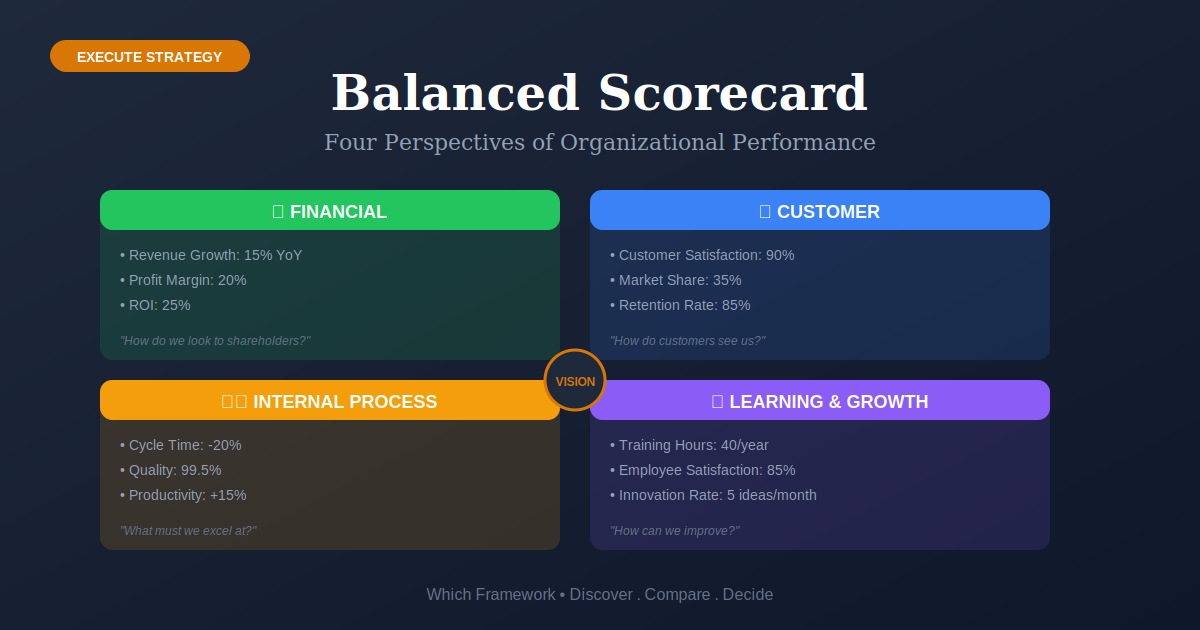
Balanced Scorecard translates organizational strategy into a comprehensive set of measurable objectives across four perspectives: Financial, Customer, Internal Process, and Learning & Growth—providing a balanced view of organizational health.
What Is It?
The Balanced Scorecard, developed by Robert Kaplan and David Norton at Harvard Business School, is a strategic management framework that addresses the limitation of traditional financial-only performance measurement. It balances financial metrics with non-financial measures that drive long-term value creation.
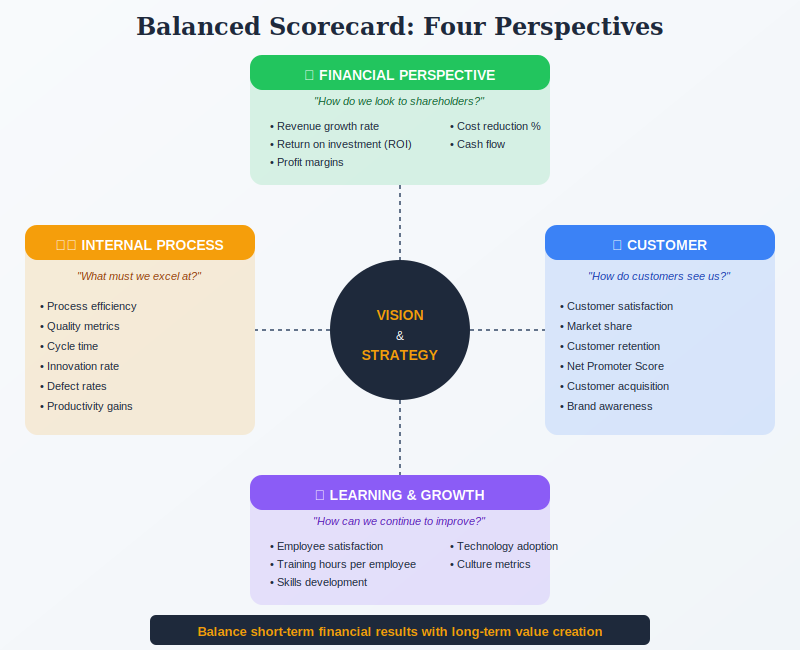
The framework organizes objectives and metrics across four perspectives: Financial (how we look to shareholders), Customer (how customers see us), Internal Process (what we must excel at), and Learning & Growth (how we can improve). Each perspective contains objectives, measures, targets, and initiatives.
The power of the Balanced Scorecard lies in showing how these perspectives are interconnected. Learning & Growth enables better Internal Processes, which drive Customer satisfaction, which ultimately delivers Financial results. This cause-and-effect chain helps organizations understand how to create long-term value.
Since its introduction in 1992, the Balanced Scorecard has evolved from a performance measurement tool to a comprehensive strategic management system used by organizations worldwide.
Quick Reference
Core Features
- Financial Perspective: Revenue, profitability, ROI, shareholder value metrics
- Customer Perspective: Satisfaction, retention, market share, brand metrics
- Internal Process Perspective: Quality, cycle time, productivity, innovation metrics
- Learning & Growth Perspective: Employee skills, culture, technology, knowledge metrics
- Cause-and-Effect Linkages: Shows how perspectives drive each other
- Leading & Lagging Indicators: Balances predictive and outcome measures
- Strategic Initiatives: Links measures to action plans
When to Use
- You need comprehensive strategy management beyond financial metrics
- Your organization is large and needs coordinated performance management
- You want to balance short-term results with long-term value creation
- You need to align operations with strategic objectives
- You're in a mature organization with established data collection
- Stakeholders need visibility into strategy execution (complementary to OKR)
- You work in enterprise, government, or nonprofit sectors
When NOT to Use
- You're a startup or small organization (too complex—consider OKR or Lean Strategy)
- You need quick decisions without extensive data collection
- Leadership isn't committed to comprehensive measurement
- You lack resources for ongoing data collection and analysis
- Your strategy changes frequently (Balanced Scorecard assumes stability)
Key Strengths
- Comprehensive View: Balances multiple dimensions of performance
- Strategy Translation: Converts abstract strategy into concrete measures
- Cause-and-Effect: Shows how actions lead to outcomes
- Long-term Focus: Balances short-term financial with long-term capability
- Proven Track Record: Decades of successful implementation across industries
Key Weaknesses
- Complex to implement correctly—requires significant investment
- Data-intensive—needs robust measurement systems
- Can become bureaucratic if not managed carefully
- Requires executive alignment and commitment
- May oversimplify complex strategic relationships
How It Works
| 1 Primary Input | Organizational vision, strategy, and current performance data |
|---|---|
| 2 Data You Need | Financial metrics, customer data, process measurements, employee surveys |
| 3 Primary Output | Scorecard with objectives, measures, targets, and initiatives across four perspectives |
Comparison with Related Frameworks
Balanced Scorecard is a comprehensive strategy management tool. Here's how it compares:
Balanced Scorecard vs OKR
OKR is simpler, focusing on objectives and key results without the four-perspective structure. BSC is more comprehensive but complex. Use OKR for goal alignment; BSC for holistic strategy management.
Balanced Scorecard vs Strategy Map
Strategy Map was developed by Kaplan & Norton as a companion to BSC. The Strategy Map visualizes cause-and-effect relationships; BSC provides the measurement system. They're often used together.
Balanced Scorecard vs Hoshin Kanri
Hoshin Kanri is the Japanese approach with similar comprehensive goals but more emphasis on cascading deployment. BSC focuses on four perspectives; Hoshin on breakthrough objectives. Both can work in large organizations.