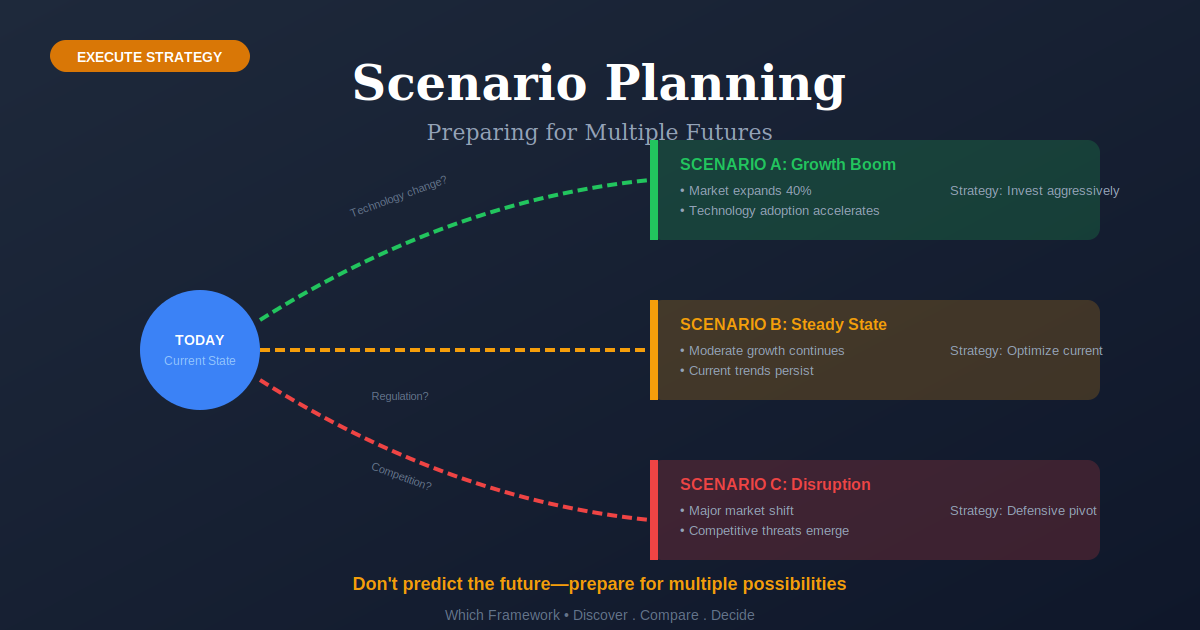
Scenario Planning: Preparing for Multiple Futures
Scenario Planning is a strategic planning method that explores multiple plausible futures to help organizations prepare for uncertainty, challenge assumptions, and build strategic resilience rather than betting on a single prediction.
What Is It?
Scenario Planning is a disciplined method for imagining possible futures and preparing organizations for them. Unlike forecasting, which attempts to predict what will happen, scenario planning explores multiple "what-ifs" to build strategic flexibility.
The approach was pioneered by Pierre Wack at Royal Dutch Shell in the 1970s. Shell's scenario planning famously helped them anticipate the 1973 oil crisis while competitors were caught unprepared. This success established scenario planning as a serious strategic tool.
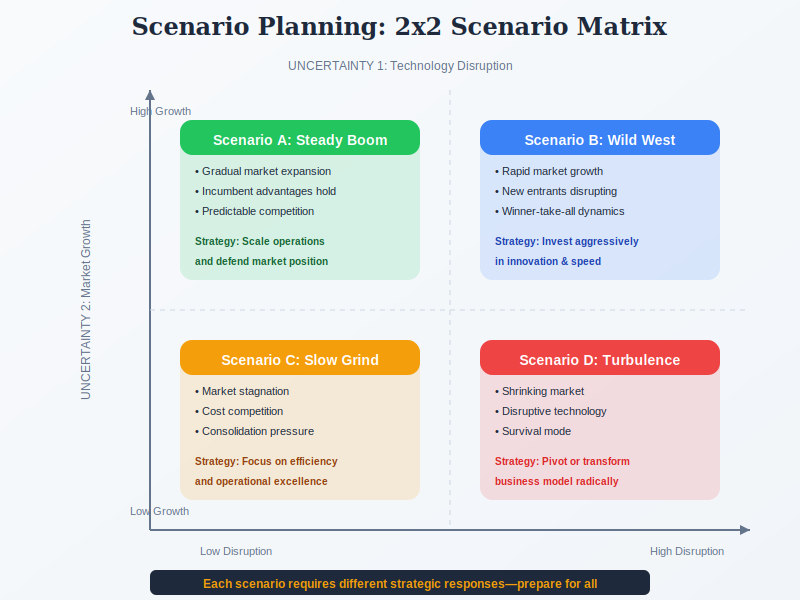
The process typically involves identifying key uncertainties (factors that could go multiple ways), combining them into internally consistent scenarios (usually 3-4), developing narratives for each scenario, and then stress-testing strategy against all scenarios to build resilience.
The goal isn't to predict the future but to expand mental models. By seriously considering multiple futures, leaders make better decisions because they're prepared for various outcomes rather than blindsided by change.
Quick Reference
Core Features
- Key Uncertainties: Identify the 2-3 factors that could fundamentally change your environment
- 2x2 Matrix: Common tool combining two uncertainties into four distinct scenarios
- Scenario Narratives: Rich, internally consistent stories about each possible future
- Strategy Stress-Testing: Evaluate current strategy against all scenarios
- Early Warning Indicators: Signals that suggest which scenario is emerging
- Strategic Options: Actions that work across multiple scenarios
- Robust Strategies: Plans that succeed regardless of which future materializes
When to Use
- You're facing high uncertainty about the future environment
- You're making long-term strategic decisions (5-10+ years)
- Your industry is prone to disruption
- The cost of being wrong is very high
- You need to challenge organizational assumptions
- You want to build strategic resilience and flexibility
- Complementary to Strategy Map for long-term planning
When NOT to Use
- You need quick tactical decisions (consider Lean Strategy)
- The future is relatively predictable
- You lack resources for 2-3 months of planning work
- Leadership wants definitive answers, not multiple possibilities
- Short-term operational planning where OKR is more appropriate
Key Strengths
- Reduces Surprise: Prepares organization for multiple outcomes
- Challenges Assumptions: Forces leaders to question beliefs about the future
- Builds Resilience: Creates strategies that work across scenarios
- Improves Decision-Making: Expands options considered
- Creates Early Warnings: Identifies signals of emerging futures
Key Weaknesses
- Time-consuming (2-3 months for thorough process)
- Can feel speculative to action-oriented leaders
- Scenarios can be wrong or miss key uncertainties
- Difficult to maintain momentum after planning
- Resource-intensive, requiring significant investment
How It Works
| 1 Primary Input | Industry trends, key uncertainties, strategic question to address |
|---|---|
| 2 Data You Need | Environmental scanning, expert interviews, trend analysis, competitive intelligence |
| 3 Primary Output | 3-4 scenario narratives, strategic options for each, early warning indicators |
Comparison with Related Frameworks
Scenario Planning vs Lean Strategy
Lean Strategy emphasizes rapid experimentation and learning. Scenario Planning is about long-term preparation. Use Lean Strategy when you can test and learn quickly; Scenario Planning when you need to plan for long-term uncertainty.
Scenario Planning vs Strategy Map
Strategy Map visualizes current strategy execution. Scenario Planning explores future possibilities. Use Strategy Map for executing known strategy; Scenario Planning for preparing for unknown futures.